


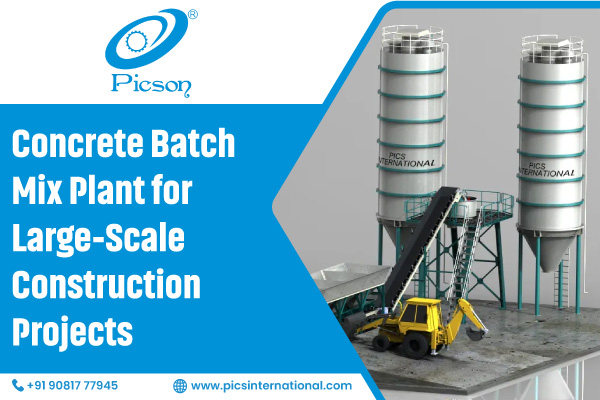
In the world of heavy construction, delivering consistent, high-quality concrete in large volumes is critical. Whether you are developing a high-rise, building roads, bridges, or undertaking massive infrastructure projects, the concrete production method can deeply affect structural integrity, project timelines, and cost-effectiveness. At Pics International, we understand these demands — which is why our modern concrete batch mix plants are designed to meet the rigorous needs of large-scale construction projects across India and beyond. In this blog, we explore what a concrete batch mix plant is, why they are indispensable for large-scale jobs, and how choosing the right plant transforms your construction workflow.
What is a Concrete Batch Mix Plant
A concrete batch mix plant — often simply referred to as a concrete batching plant — is an automated system that mixes raw components (cement, aggregates like sand and gravel, Carefully measured quantities of cement, aggregates, water, and chemical additives are combined in exact ratios to produce high-quality ready-mix concrete.
Instead of manual mixing on-site — which can lead to inconsistent mix ratios, variable quality, and inefficiencies — a batch mix plant streamlines the process: raw materials are stored in separate bins or silos, weighed automatically, conveyed into a mixer, blended thoroughly, and then discharged for immediate use or transport.
This method yields uniform concrete quality, ensures repeatability of mix specifications, and suits projects that require reliable output at scale.
Why Batch Mix Plants Are Critical for Large-Scale Construction
For small-scale or intermittent construction tasks, manual mixing might suffice. But for large-scale construction projects — such as residential complexes, commercial buildings, bridges, roads, or industrial infrastructure — a batch mix plant offers advantages that are hard to replicate manually. Key benefits include:
- Consistent Quality Across Batches: Because ingredients are measured accurately and mixed under controlled conditions, each batch of concrete has uniform strength, workability, and composition — essential for structural integrity in large builds.
- High Production Capacity & Speed: Batch plants are capable of producing large volumes of concrete quickly, meeting the high demand typical in large-scale projects.
- Flexible capacity and mix adaptability: Batch plants allow mix designs to be adjusted based on project requirements, from standard concrete to high-strength and specialized blends for precast and heavy-duty applications. can be scaled up as per project size.
- Cost Efficiency Over Time: Automation reduces labor dependency, minimizes material wastage, and reduces rework due to poor mixes. Over the life of a project, these savings accumulate significantly.
- Improved Safety and Environment Compliance: Modern plants often include dust control, enclosed silos, and waste-management systems — reducing onsite pollution, dust, and health hazards for workers.
- Consistent production and prompt dispatch: On-site or nearby batching plants allow concrete to be produced as required, minimizing dependence on third-party suppliers and reducing transportation-related delays.This helps keep large, time-critical projects on track.
Components & Working Principle of a Concrete Batch Mix Plant
To appreciate why batch mix plants, deliver such value, it’s helpful to understand their core components and working process:
- Aggregate Storage Bins / Silos: Separate compartments for sand, crushed stone, gravel, or other aggregates. Ensures proper storage, segregation, and ready access.
- Weighing / Metering Systems: Electronic sensors and weighing modules measure precise quantities of each material — aggregates, cement, water, additives — to maintain mix proportions within tight tolerances.
- Mixing Host / Mixer (e.g. Twin-Shaft Mixer): In many modern plants, a twin-shaft forced mixer blends all components rapidly and uniformly — even when handling coarse aggregates or heavy-duty mixes.
- Automated control and monitoring system: PLC-based or computerized control panels regulate the complete operation cycle, including material feeding, accurate weighing, mixing, and discharge, which significantly reduces manual involvement and operational e
- Conveyors / Elevators / Skip Hoists: For transporting aggregates from storage to mixer efficiently, especially when materials are bulky or heavy.
- Environmental protection and waste handling systems: Integrated dust collectors, sealed silos, and water or material recycling units help control airborne particles, manage residues efficiently, and support compliance with environmental regulations.
- Batch-wise tracking and performance recording: Modern plants store detailed data for every production cycle, including mix proportions, batch identification, time stamps, and operator inputs, supporting full traceability, quality verification, and consist
Applications: Where Batch Mix Plants Show Their Strength
Concrete batch mix plants are suitable for a variety of large-scale and diverse construction projects, including:
- Multi-storey residential and commercial buildings where consistent concrete strength and volume is critical
- Road and highway construction — where massive quantities of concrete may be needed for pavements, foundations, bridges
- Infrastructure projects like bridges, flyovers, dams, tunnels — requiring high-quality concrete and strict compliance with safety and structural standards
- Precast concrete manufacturing plants — producing beams, columns, slabs, structural components under controlled conditions
- Industrial and infrastructural developments: ports, airports, warehouse buildings, industrial complexes — were reliability and quality of concrete matter for durability
- Urban development projects: high-rise complexes, metro stations, flyovers, and other large-scale works requiring quick, high-volume concrete supply
Challenges & Considerations: What to Evaluate Before Investing
While concrete batch mix plants provide many benefits, large-scale projects and companies must consider certain factors before investing:
- Initial Investment Cost: High-capacity batch plants require significant capital outlay — cost of equipment, installation, infrastructure (silos, conveyors), and setup.
- Site Requirements: Adequate space for bins, silos, storage of raw materials; stable foundation; good access for raw material and ready-mix transport.
- Dependence on transport and site infrastructure: Stationary plants rely heavily on consistent road connectivity, availability of transport vehicles, and uninterrupted raw material supply, as weak infrastructure can directly affect production continuity.
- Mobility vs Stationarity Trade-off: Mobile or modular plants provide flexibility for temporary or remote job sites but may come with lower capacities compared to fixed installations.
- Environmental and Regulatory Compliance: Dust, noise, wastewater — plant design must include dust suppression, dust collection, waste-water treatment if needed, to abide by environmental norms.
- Operating & Maintenance Requirements: Even with automation, maintenance of mixers, wear parts, conveyors, silos is necessary to sustain performance and longevity.
Why Choose Us
Pics International stands out as your trusted partner for concrete production solutions. As a respected Concrete Batch Mix Plant Manufacturer in Gujarat and a leading Construction Equipments Manufacturer in India, we deliver plants engineered with high-grade materials, modern automation, and customizable configurations tailored to your project’s unique demands. Our experience in handling large-scale construction requirements across varied terrains and conditions ensures smooth project execution, reliable supply, and durable performance — thereby helping you complete projects on schedule, within specification, and cost-efficiently.
Conclusion
Implementing a concrete batch mix plant revolutionizes the way large-scale construction projects approach concrete production. With precise automated mixing, uniform quality in every batch, and the ability to generate concrete at high volumes quickly, batch plants become indispensable for reliable, scalable, and efficient construction. They reduce wastage, cut down labor and material costs, and deliver concrete that meets rigorous structural demands. For ambitious infrastructure, building, or industrial projects that require consistency, volume, and timely supply — a batch mix plant from Pics International proves to be a valuable, long-term investment.
For more information about this blog or our concrete batch mix plant solutions, call us at +91 90817 77945 or email sales@picsinternational.com.
FAQs
What types of projects benefit most from a concrete batch mix plant?
Large-scale construction projects such as high-rise buildings, bridges, roads, infrastructure projects, precast manufacturing, and commercial developments benefit significantly. Any project requiring consistent concrete quality and high-volume supply will find a batch mix plant valuable.
How does a batch mix plant ensure consistency compared to on-site manual mixing?
Because raw materials (cement, aggregates, water, additives) are weighed precisely by electronic sensors, and mixing is done in a controlled mixer under predefined cycles, every batch meets design specifications — eliminating inconsistencies typical of manual mixing.
Can batch mix plants be customized to different concrete mixes (e.g., high-strength, lightweight, special concrete)?
Yes. Batch mix plants support flexible mix design — proportions of cement, aggregates, water, and additives can be adjusted to create standard, high-strength, lightweight, or specialized concrete as per project requirements.
What are the main considerations before installing a batch mix plant for a large project?
Important factors include available space for silos and raw material storage, reliable supply of raw materials, proper site infrastructure (access roads, foundation), and long-term maintenance plan to keep equipment functioning optimally.
Is investing in a concrete batch mix plant cost-effective for large-scale construction projects?
Though initial investment may be substantial, long-term benefits — consistent quality, reduced material wastage, lower labor and rework costs, high output — often make the investment cost-effective for large or multiple projects over time.