




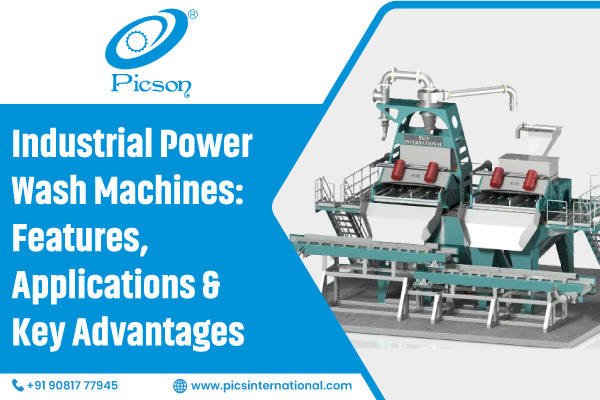
Industrial cleaning and material processing require robust, efficient systems that can handle heavy loads — that’s where industrial power wash machines come in. In this blog, we discuss the functionality, benefits, and applications of such machines, with a focus on power-wash systems from Pics International. We also highlight the role of hydrocyclone technology — and why Pics International, a reputed Hydrocyclone Manufacturer in India (and specifically a Hydrocyclone Manufacturer in Gujarat), stands out in the market.
What Are Industrial Power Wash Machines?
Industrial power wash machines — often called “power wash systems” — are heavy-duty cleaning and washing solutions designed for industrial-scale operations. Unlike regular consumer pressure washers, these machines are engineered to handle large volumes of materials such as sand, gravel, mineral slurries, or industrial waste. Their purpose extends beyond simple cleaning: they help wash, dewater, and separate materials to meet quality standards required in construction, mining, and recycling industries.
A key component of many of these systems is the hydrocyclone — a static, cone-shaped separation device that uses centrifugal force to separate solids from liquids.
Because hydrocyclones have no moving parts, they are simpler, more reliable, and lower maintenance than dynamic separation systems such as centrifuges.
How Does a Hydrocyclone Work
When slurry (a mixture of water and solid particles) enters a hydrocyclone tangentially under pressure, it creates a vortex inside the cylindrical/conical chamber. The swirling action induces centrifugal force, pushing heavier particles outward and downward along the walls, while lighter fluid (and finer particles) spiral upward. The heavier particles exit through the bottom (underflow), while the cleaner liquid (and fine particles) exit through the top (overflow).
Because of differences in density and shape of particles, hydrocyclones are especially effective in separating heavier solids (like sand, silt, minerals) from water or slurry, making them ideal for industries dealing with sand washing, ore processing, or wastewater cleaning.
Key Features of Industrial Power Wash Machines
When you combine power wash systems with hydrocyclone technology, several powerful features emerge:
- High-pressure cleaning and separation: These machines deliver strong water pressure to wash away dirt, clay, fines, and impurities; at the same time, the hydrocyclone helps separate solids from water efficiently, improving material quality.
- Dewatering capability: After washing, materials (e.g., sand) are dewatered effectively, resulting in cleaner, drier output ready for construction or further processing. As described for the “Power Wash” series by Pics International, dewatering size and pump power are optimized for efficient material handling.
- Robust construction & durability: Industrial-grade materials and strong build quality allow these machines to withstand harsh operational conditions, abrasive slurry, and continuous usage.
- Space-efficient design: Despite their power, well-designed systems maintain a compact footprint, enabling integration into existing plants without requiring excessive space — as exemplified by the size variants in Pics International’s Power Wash series.
- Versatility across materials: These systems can handle sand, aggregates, minerals, industrial slurry, and even waste or recycled materials. Useful for industries like construction, mining, manufacturing, and waste recycling.
- Lower maintenance and operational costs: Thanks to the hydrocyclone’s lack of moving parts, maintenance is simpler, and operational costs are reduced over time compared to mechanical separators.
Common Applications of Industrial Power Wash Machines
Here are some of the major industrial uses where power wash machines (with hydrocyclone integration) make a significant impact:
- Sand and Aggregate Washing: In construction and infrastructure projects, sand must be free from fines, clay or dirt for high-quality concrete production. Power wash machines help clean and dewater sand efficiently.
- Mineral Processing & Mining: Raw ore and mineral mixtures often carry impurities, mud, fine particles — hydrocyclone-based washing helps separate and classify materials before further processing.
- Waste Recycling & Construction Debris Handling: When recycling materials from demolition or construction waste, washing and separation ensure cleaner output, suitable for reuse. Systems offered by a manufacturer like Pics International can be tailored for such specialized tasks.
- Industrial Slurry Treatment: Industries generating slurry (e.g. ore processing, mining, metalworking) can treat slurry to separate solids and water, reducing waste and improving resource recovery.
- Water Treatment and Environmental Applications: Hydrocyclones are used in water treatment, desalination pre-treatment, removing sand or silt from water — beneficial for irrigation systems, wastewater management, or filtration pre-processing.
Why Choose Pics International?
At Pics International, you get a combination of experience, quality engineering, and tailored solutions:
- Their Power Wash series (D-100, D-150, D-200) offers a range of capacities — from 80–100 TPH up to 150–200 TPH — enabling you to select machines based on your operational scale.
- The use of hydrocyclone technology ensures efficient separation and dewatering, improving the quality of washed sand or aggregates.
- Their machines are designed to be compact yet sturdy, which helps integrate smoothly into existing plants without major infrastructure changes.
- Maintenance is streamlined, reducing downtime and operational costs — a major advantage for industries operating continuously.
- As an established Hydrocyclone Manufacturer in India and Hydrocyclone Manufacturer in Gujarat, Pics International ensures prompt support, spare-parts availability, and compliance with local industrial standards — crucial for long-term reliability and performance.
Conclusion
Industrial power wash machines equipped with hydrocyclone technology offer a robust solution for industries needing efficient washing, dewatering, and separation of materials like sand, aggregates, minerals, or industrial slurry. With careful design — high pressure washing, intelligent hydrocyclone separation, durability, and high throughput — these machines significantly improve operational efficiency, material quality, and reduce wastage and maintenance overhead. For businesses in construction, mining, recycling or water treatment, investing in state-of-the-art power wash systems can lead to long-term benefits in productivity and cost savings.
If you’d like more information on Industrial Power Wash Machines: Features, Applications & Key Advantages — contact us at +91 9081777945 or email sales@picsinternational.com. We’re ready to help you choose the right solution for your needs.
FAQs
What is a hydrocyclone and why is it used in power wash machines?
A hydrocyclone is a cone-shaped separation device that uses centrifugal force to separate solids from liquids based on density differences, operating without moving parts. It is used in power wash machines to efficiently dewater and separate sand, sludge or slurry from water — improving output quality and reducing waste.
Can power wash machines handle high-capacity industrial material processing?
Yes. Modern industrial power wash machines are built for large volumes. For instance, Pics International’s Power Wash D-150 and D-200 models process 100–150 TPH and 150–200 TPH respectively — suitable for heavy-duty sand, aggregate, or mineral washing.
Is maintenance complicated for hydrocyclone-based systems?
No. Since hydrocyclones have no moving parts, maintenance is simpler compared to mechanical separators. Regular checks suffice for longevity and stable performance.
What types of industries benefit most from these machines?
Industries including construction (sand & aggregates), mining and mineral processing, recycling, waste management, and slurry-producing manufacturing benefit greatly. Also, water treatment and filtration-based industries can use hydrocyclone-based washing systems.
How does using a power wash machine improve material quality compared to traditional washing or manual methods?
Power wash machines — especially with hydrocyclone separation — remove fine particles, clay, silt and impurities more thoroughly than manual or gravity-based washing. This results in cleaner, dewatered, high-quality sand or aggregates that meet construction or processing standards.