



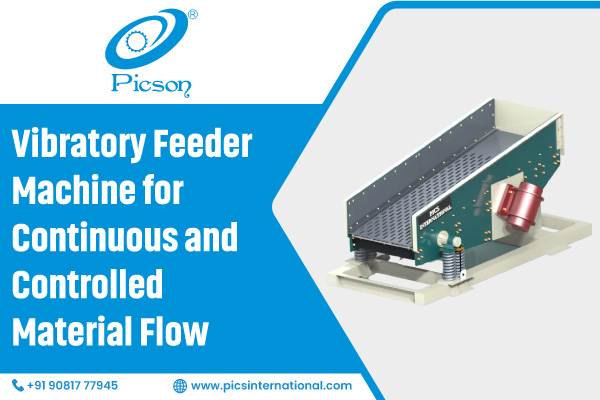
In material-handling and construction operations, delivering a consistent and controlled flow of bulk materials — whether granular aggregates, sand, stones, powders or other free-flowing substances — can make or break the efficiency and reliability of your process. At Pics International, we understand how critical material flow control is, which is why we offer high-quality vibratory feeder machines. In this blog, we explore what a vibratory feeder machine is, why such machines matter, and how choosing the right feeder can transform your operations.
What is a Vibratory Feeder Machine
A vibratory feeder (also known as a vibrating feeder) is an industrial device designed to move bulk materials from a storage hopper or bin to downstream equipment in a smooth, continuous, and controlled manner.
Unlike belt conveyors or screw conveyors which move material en masse along a belt or screw, a vibratory feeder uses vibration — often generated by electromagnetic drives or unbalanced motors — to gently “shake” or “vibrate” the material along a trough or pan, using gravity to guide the direction of flow.
This vibratory motion causes material to move in small, controlled increments, resulting in a steady, even discharge rate — whether handling powders, granules, stones, aggregates, or other bulk materials.
Why Vibratory Feeders Are Critical for Continuous and Controlled Material Flow
- Gentle handling with minimal damage: Because vibratory feeders rely on vibration plus gravity — rather than mechanical pressure or brute force — they transport material in a gentle way that prevents degradation, breakage, or segregation of batches. This is especially important for fragile, friable, or irregular particles and bulk materials.
- Smooth, uniform flow: Vibratory feeders regulate material flow in a manner similar to how valves or orifices control fluid flow. This ensures the downstream process receives material in a consistent, uniform stream — avoiding surges, clogs, or inconsistent feed rates.
- Adaptable for diverse materials and industries: Vibratory feeders efficiently handle a wide range of materials such as fine powders, granules, aggregates, ores, and construction-grade raw inputs with consistent performance. Industries from mining and metallurgy to construction, cement, concrete, sugar, chemical, and fertilizer plants use them for controlled material feeding.
- High efficiency, low maintenance: Since vibratory feeders often have no belts, chains, or complex mechanical linkages — just a vibratory drive plus a trough/pan supported on springs — they have fewer wear-points and require minimal maintenance. This translates to less downtime and lower lifecycle costs.
- Flexible integration into existing plants: Because of their relatively compact footprint and modular design, vibratory feeders can be integrated into existing process flows — from hoppers and bins to crushers, screens, mixers, conveyors, or packaging/sorting lines.
Applications of Vibratory Feeders
Vibratory feeders are widely used across many sectors and for a variety of materials. Typical applications include:
- Feeding bulk materials (sand, gravel, aggregates) into crushers or screening units in mining, quarrying or construction applications.
- Supplying raw materials (powders, granules, chemicals) into mixing, blending, or processing units in chemical, fertilizer, cement or other heavy-industry plants.
- Feeding and distributing materials in manufacturing, foundry, metalworking, and recycling operations — including ores, scrap metal, glass, plastics, and more, for further processing.
- Handling bulk materials for industries like cement, concrete, bricks, minerals, building materials — especially where reliable, steady flow is important for continuous operations.
Key Advantages Over Conventional Conveying Methods
Using a vibratory feeder machine instead of conventional conveyors or feeders offers several distinct advantages:
- Reduced mechanical complexity: Without belts, rollers, or chains, vibratory feeders have fewer components that wear out, reducing maintenance.
- Improved material integrity: Through gentle vibration, materials are less likely to degrade, break, or segregate — a major benefit when handling fragile or mixed materials.
- Consistent feed rate and flow control: Adjustable vibration frequency and amplitude allow precise control over throughput and flow rate — from a few kilograms per hour to several tons per hour depending on design.
- Versatility and flexibility: Feeders can be customized (tray size, vibration motor type, material of construction) to suit different materials, environmental conditions, and integration needs.
- Lower energy consumption: Because the vibratory motion moves only the material (not a heavy belt or chain), power requirements are often lower compared to conventional conveyor systems.
Why Choose Us
Pics International stands out as a trusted partner when it comes to vibratory feeder solutions. As a leading Vibratory Feeder Manufacturer in Gujarat and among the top Vibratory Feeder Manufacturers in India, we bring deep industry knowledge, engineering excellence, and quality manufacturing to every project. Our feeders are built to perform consistently under Indian industrial conditions, with customizable options to meet your unique material handling needs. Whether you run a construction, mining, cement, or industrial processing plant — Pics International combines reliability, durability, and tailored solutions to help your operations run smoothly and efficiently.
If you want to explore how a vibratory feeder machine from Pics International can benefit your plant — in terms of continuous flow, controlled discharge, and operational reliability — do not hesitate to reach out.
Conclusion
Vibratory feeder machines offer an efficient, reliable, and versatile solution for continuous and controlled material flow in industrial and construction applications. By combining vibration with gravity, they deliver smooth, uniform discharge of bulk materials — from powders and granules to coarse aggregates — while minimizing material damage, reducing maintenance needs, and improving process efficiency. For operations requiring steady feed rates, high throughput, and robust performance, a vibratory feeder stands out as a superior alternative to conventional conveyors and feeding systems.
For more information about this blog or our vibratory feeder solutions, call us at +919081777945 or email sales@picsinternational.com.
FAQs
What types of materials can be handled by a vibratory feeder?
A vibratory feeder can handle a wide range of bulk materials — from powders, granules, and small particles to coarse aggregates, ores, sand, gravel, stone chips, and other free-flowing or semi-free-flowing materials.
How does a vibratory feeder maintain a continuous and controlled flow?
By combining vibration (often via electromagnetic drives or unbalanced motors) with gravity along a tilted trough or pan, the feeder gently moves material forward in small increments. The vibration parameters (frequency, amplitude) can be tuned to regulate the flow rate and volume per unit time.
Is a vibratory feeder suitable for heavy or abrasive materials like stone, ore, or concrete aggregate?
Yes. Vibratory feeders are widely used in heavy-duty industries like mining, metallurgy, construction, and aggregate processing. Their robust build and design allow them to handle abrasive, coarse, or heavy bulk materials reliably.
What are the maintenance requirements for a vibratory feeder?
Since vibratory feeders have fewer moving parts (no belts or chains), wear and tear are lower, and maintenance is minimal compared to conventional conveyor systems. Replacement of wear liners, occasional inspection of springs and vibratory drives, and routine cleaning (if handling dust or fines) are usually sufficient.
Can vibratory feeders be customized for specific plant requirements?
Absolutely. Vibratory feeders can be customized in terms of tray/pan size, vibration drive type (electromagnetic or unbalanced motor), feed capacity, feed rate control, material of construction, and integration design — to suit various materials and plant layouts. This flexibility makes them ideal for diverse industrial requirements.