


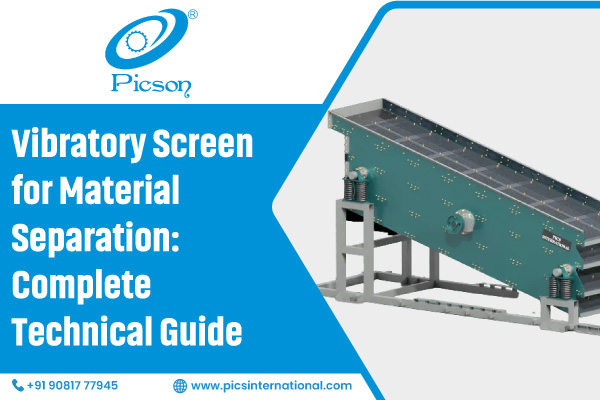
In modern industrial operations, accurate and efficient material separation decides the overall productivity and final product quality. A vibratory screen plays a vital role in this process by separating materials based on size through controlled vibration. From mining and quarrying to construction and chemical processing, vibratory screens have become an essential part of material handling systems. At Pics International, advanced vibratory screen solutions are developed to meet the growing demands of high-capacity screening with precision and durability. As one of the leading Vibratory Screens Manufacturer in India, Vibratory Screens Manufacturer in Gujarat, recognized among top Screen Manufacturers in India, and a trusted Screens Manufacturer, the company delivers reliable screening systems for a wide range of industrial applications.
Understanding Vibratory Screens and Their Role in Material Separation
A vibratory screen is a mechanical screening machine used to separate materials into various sizes using vibration. The machine causes the screen surface to vibrate, allowing particles smaller than the mesh size to pass through while larger particles move along the surface to the discharge point. This separation method improves processing efficiency, maintains uniform particle size, and supports uninterrupted production flow.
In large-scale industrial setups, manual or gravity-based screening methods lack consistency and speed. Vibratory screens solve these limitations by offering controlled vibration, adjustable screening parameters, and continuous operation. That is why industries prefer systems supplied by a reputed Vibratory Screens Manufacturer in India and a proven Screens Manufacturer for long-term operational reliability.
Construction and Working Principle of a Vibratory Screen
A vibratory screen mainly consists of the following core components:
- Screen Deck: The surface where material is fed and separation takes place. Decks can be single, double, or multi-deck depending on output requirements.
- Vibration Motor or Exciter: Generates controlled vibration that moves the material across the screen.
- Screen Mesh or Panels: Made of wire mesh or polyurethane, selected based on application and material type.
- Spring or Suspension System: Supports the screen body while allowing vibration movement.
- Feed Inlet and Discharge Outlets: Control material entry and exit during screening.
The working process starts when raw material enters the screen through the feed inlet. The vibration motor creates linear or circular motion, depending on design. As material moves across the deck, finer particles pass through the mesh while oversized particles travel forward and discharge separately. This process continues continuously without production interruption, making vibratory screens ideal for high-capacity plants supplied by a reliable Vibratory Screens Manufacturer in Gujarat or well-known Screen Manufacturers in India.
Types of Vibratory Screens Used in Industrial Applications
Different industries require different screening solutions based on material characteristics and capacity demands. The common types include:
- Linear Vibratory Screens: Used for material classification, dewatering, and sizing with linear motion. These are suitable for bulk materials and wet screening processes.
- Circular Vibratory Screens: Provide circular motion for accurate separation of materials with varied particle sizes. Mostly used in quarry and mining applications.
- Multi-Deck Vibratory Screens: Allow separation into multiple size fractions in a single operation. Widely preferred in aggregate processing plants.
- Heavy-Duty Vibratory Scree: Designed for harsh mining environments with high load and abrasive materials.
As a trusted Screens Manufacturer, Pics International supplies these variants with customized capacities and structural strength for long service life.
Key Technical Features of Vibratory Screens
A high-quality vibratory screen is defined by its technical strength and operational stability. Some prominent technical features include:
- High screening efficiency with uniform vibration distribution
- Rigid structure that handles continuous heavy-duty operations
- Low power consumption with optimized vibration transmission
- Adjustable stroke and screening angles for custom requirements
- Wear-resistant screen panels for extended service life
- Minimal downtime due to simplified maintenance design
These features greatly influence productivity, which is why industrial buyers prefer sourcing machines from an experienced Vibratory Screens Manufacturer in India rather than opting for generic alternatives.
Applications of Vibratory Screens Across Industries
Vibratory screens are used across multiple industrial sectors due to their adaptability and performance consistency. Major application areas include:
- Mining and Mineral Processing: Used to screen ores, coal, limestone, and other minerals after crushing. Precise sizing improves downstream processing efficiency.
- Construction and Aggregate Processing: Critical in separating sand, gravel, and crushed stone for concrete and asphalt production.
- Cement Plants: Used to classify raw materials and finished cement for uniform particle distribution.
- Chemical and Fertilizer Industries: Helps separate powders, granules, and slurry-based materials with desired particle size.
- Recycling and Waste Management: Screens segregate recyclable materials such as metal fragments, glass, and construction debris.
Industries that rely on continuous separation performance often trust reputed Screen Manufacturers in India and established Vibratory Screens Manufacturer in Gujarat for their project needs.
Advantages of Using Vibratory Screens for Material Separation
The popularity of vibratory screens is driven by the multiple technical and operational advantages they offer:
- High screening accuracy and consistent output quality
- Suitable for both dry and wet screening applications
- Capable of handling large feed volumes
- Reduces manual labor and operational delays
- Improves plant productivity and process efficiency
- Low operating cost compared to traditional screening systems
As a dependable Screens Manufacturer, Pics International designs screens that balance performance with long-term cost efficiency for industrial users.
Quality Standards and Manufacturing Precision
A well-manufactured vibratory screen undergoes strict quality inspection during fabrication. Structural welding, material selection, vibration balancing, and load testing play an important role in achieving durability. Leading Screen Manufacturers in India follow quality-controlled production practices that enhance machine life and reduce vibration-related stress failures.
At Pics International, machines are engineered with precision components and rigid structural frameworks built for long operational life.
Maintenance Requirements and Operational Reliability
Proper maintenance directly impacts the service life and performance of vibratory screens. Routine inspection of screen panels, vibration motors, suspension springs, and fasteners is essential. Lubrication schedules for motors and bearings also play a major role in reducing mechanical wear.
Industrial users prefer sourcing equipment from a proven Screens Manufacturer because it simplifies spare part availability and technical support. As a reliable Vibratory Screens Manufacturer in Gujarat, Pics International supports long-term operations through consistent service assistance.
Role of Vibratory Screens in Process Automation
Automation-driven plants require consistent and predictable material flow. Vibratory screens support automated production by maintaining continuous screening without feed variations. Integration with conveyor systems, crushers, and feeders streamlines the entire processing line. This automation support increases throughput while maintaining strict quality output defined by the project engineers.
Environmental and Safety Benefits of Vibratory Screens
Modern vibratory screens also help industries comply with safety and environmental standards. Controlled screening reduces material spillage and dust formation. Advanced covers and enclosed designs support eco-friendly operations. Reduced manual handling also lowers workplace injury risks, creating a safer production environment.
Why Choose Us
Choosing Pics International means partnering with a company focused on precision engineering, consistent quality, and long-term industrial performance. As both a trusted Vibratory Screens Manufacturer in India and Vibratory Screens Manufacturer in Gujarat, the company delivers machines designed to handle high capacities with stable vibration and minimal operational loss. With a strong manufacturing base and deep industry understanding as one of the leading Screen Manufacturers in India and a dependable Screens Manufacturer, the company supports projects with customized solutions, technical guidance, and strong after-sales coordination that adds real value to every installation.
Conclusion
Vibratory screens remain a critical component in industrial material separation due to their accuracy, capacity handling, and operational stability. From mining and construction to recycling and chemical processing, these machines support consistent production quality and higher plant efficiency. Selecting the right screen design directly influences output performance and operational reliability. With advanced engineering, controlled vibration systems, and durable construction, modern vibratory screens support long-term industrial operations with minimal interruption. For any project that demands precise classification and dependable performance, investing in a high-quality vibratory screening system becomes a strategic and performance-driven decision.
For expert guidance on Vibratory Screen for Material Separation: Complete Technical Guide, call +91 9081777945 or email sales@picsinternational.com to explore the right screening solution for your industry.
FAQs
What materials can be processed using vibratory screens?
Vibratory screens can process sand, aggregates, ores, coal, chemicals, construction debris, and recycled materials across multiple industrial sectors.
How do multi-deck vibratory screens improve productivity?
Multi-deck screens allow material classification into different size ranges simultaneously, reducing handling time and supporting faster processing cycles.
What factors decide the capacity of a vibratory screen?
Deck size, vibration amplitude, screen aperture, feed rate, and material properties influence overall screening capacity.
Are vibratory screens suitable for wet screening applications?
Yes, specially designed vibratory screens operate efficiently in wet screening and slurry-based separation processes.
How long does a vibratory screen typically last?
With proper maintenance and quality construction from a reliable Screens Manufacturer, vibratory screens can operate effectively for many years in continuous industrial service.