







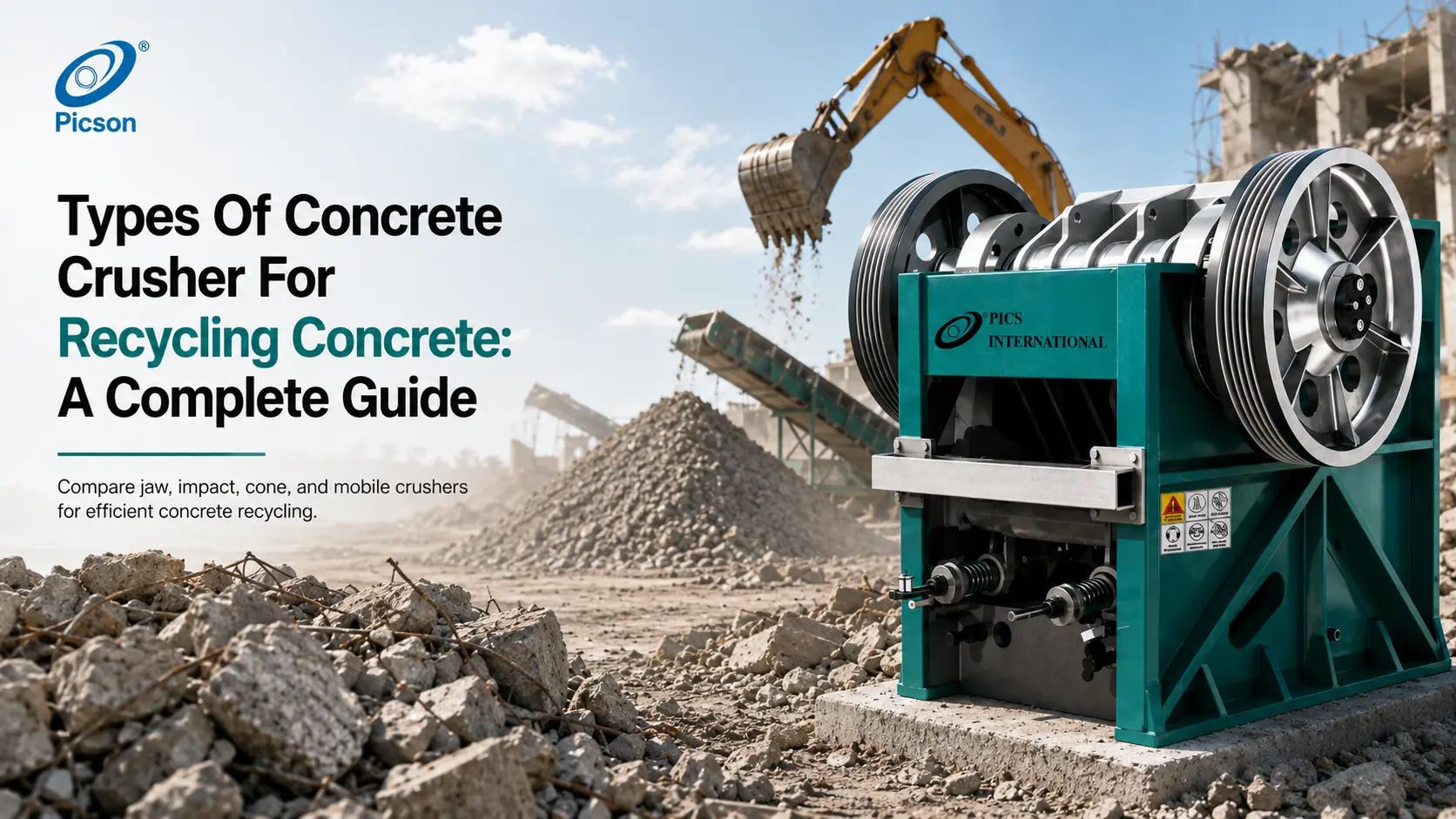
A demolition site rarely looks like a design problem, but it is one. Broken slabs, chunks of foundation, rebar poking out at odd angles, someone has to decide what happens to all of it. Haul it to a landfill and pay for both the dumping and the fresh aggregate you'll need later, or crush it on site and turn debris into base material you can actually reuse. Most contractors these days pick the second option. The harder question is which crusher machine actually does that job well for their specific site, volume, and budget.
This guide is really about one thing. Recycling concrete is not that hard to understand. It can get confusing when you start looking at all the different machines. You have jaw crushers, impact crushers and cone crushers. Then there are the big machines that can do all of these things at once. Each machine works with concrete in a way so if you pick the wrong one you will either not break down the concrete enough or you will pay for a machine that is too big for what you need.
What Is a Concrete Crusher and Why Recycling Matters?
A concrete crusher is a machine that breaks down concrete into smaller pieces that can be used again. These pieces are usually sorted by size. Can be used for things like roads filling in holes or making new concrete. The basic idea of a crusher is simple. It breaks down big pieces of concrete into smaller pieces that are all the same size. Different machines do this in different ways depending on how they are made.
Recycling concrete where it is being used cuts down on the amount of waste that goes into landfills and saves money on transportation. It also means we do not need to dig up much new material from the ground. Concrete recycling is important because it helps reduce waste and saves money. Recycling concrete, on site is a way to do this. For large infrastructure and demolition projects, this isn't a minor efficiency gain. It changes the economics of the whole job, since hauling debris off-site and trucking in new aggregate are both expensive, time-consuming steps that recycling can shortcut.
Main Types of Concrete Crushers for Recycling
Not every crusher machine does the same job. Some are built for the first, rough breakdown of large slabs. Others refine that material further into usable aggregate. Here's how the main categories differ.
Jaw Crushers
jaw crushers are the machines that start the process. They take chunks of old concrete that has been demolished and break them down into smaller pieces. This happens before anything else is done to the concrete. Jaw crushers work by squeezing the concrete between two plates. One plate does not. The other plate moves. The concrete gets crushed because the plates squeeze it than hitting it. Jaw crushers do this by using a squeezing motion to break the concrete into pieces. The jaw crusher is very important because it breaks the concrete down, to a size that's easy to work with.
They're a solid choice for large, dense concrete blocks and can handle embedded rebar reasonably well, though very heavily reinforced concrete may need pre-processing to remove excess steel first. Jaw crushers tend to be durable and relatively simple mechanically, which is part of why they remain a default primary crusher on many demolition and recycling sites.
Impact Crushers
Impact crushers break material by using high-speed impact of compression. The concrete hits a set of hammers or blow bars. Shatters when it makes contact. This process creates a cubical and uniform particle shape. This is important if the recycled aggregate has to meet quality standards for use, in new construction.
Concrete recycling is not that hard to understand. When you start looking at the machines it gets really confusing. You have to compare jaw crushers and impact crushers and cone crushers. Then there are the mobile rigs that can do several things at once. The thing is, each type of machine works with concrete in its way. So if you pick the one you will either not process your concrete enough or you will pay for something that is too big for what you need. Concrete recycling and the machines used for it, like jaw crushers and cone crushers are important to get right.
Cone Crushers
Cone crushers are usually used after the stage. They are not the machine to crush the material. They work by crushing the material between a rotating cone and a fixed bowl. This makes the material finer and evenly sized than a jaw crusher could do on its own.
For recycling concrete cone crushers are not usually the choice. They are very useful when a project needs very fine material for making concrete rather than just using it for roads or filling in holes. They can handle material that has some metal in it better than material that is really mixed up with things. So the material often goes through a jaw or impact crusher first to get rid of the metal.
Mobile and Track-Mounted Crushing Plants
Mobile crushers are not one way of crushing. They can have a jaw, impact or cone crusher on a platform that can move on wheels or tracks. This means they can go right to the site where the material's instead of having to take the material to a fixed plant. For recycling concrete this is really important. It saves a lot of money because it is very expensive to move material to a different place.
These mobile units are being used more and more in cities where space is limited. It would cost a lot to move the material. Many companies that make crusher machines now make lines that can do lots of things like crushing, sorting and even separating metal all, in one machine that can move around. There's also a real difference in how types crusher machine manufacturers put these lines together, since some only build one or two crusher types while others offer a full range from jaw through mobile.
Hammer Mill Crushers
Hammer mills use swinging hammers to pulverize material through repeated impact, and they're better suited to softer or more brittle concrete than to dense, highly reinforced structural concrete. They're less common as a primary choice for heavy demolition debris but do show up in recycling operations dealing with lighter concrete waste or specific aggregate size requirements.
How to Choose the Right Crusher Machine for Your Recycling Project?
Picking between these types comes down to a handful of practical, project-specific factors rather than a single best answer.
- Volume and material size. Large demolition jobs with oversized slabs generally need a primary crusher, jaw or impact, before anything else. Smaller-scale projects with pre-broken material might skip straight to a secondary stage.
- Rebar content. Heavily reinforced concrete needs a crusher and separation setup that can handle steel without excessive downtime. Impact crushers paired with magnetic separators are a common combination for this reason.
- Output requirements. If the recycled material just needs to serve as compacted base or backfill, a single-stage jaw crusher output is often sufficient. If it needs to meet aggregate specifications for new concrete, a secondary cone crushing stage usually becomes necessary.
- Site constraints. Urban sites with limited space and strict noise or dust regulations often favor mobile, enclosed units over larger stationary plants.
- Budget, both upfront and ongoing. Jaw crushers tend to have lower maintenance costs but produce a less uniform output. Impact crushers cost more to maintain because of wear part replacement but produce better-graded aggregate. There's no universally ideal choice here, it genuinely depends on what the project needs and how the economics work out over the equipment's service life .
Sourcing a Crusher Machine: What to Look for in Manufacturers
So you have decided on the kind of crusher that's right for your project. Now you need to think about where you will get it from. This is just as important, as the crusher you choose.
First you should look at the manufacturers history. What kind of support they offer after you buy the machine. A crusher machine is something you will use for a time so it is really important that you can get spare parts and that there are people who can fix it when it breaks. This will help make sure the machine is working when you need it to.
You should also ask the manufacturer about testing the materials you will be using. If they have any suggestions for your specific site. Good stone crusher manufacturers in India will want to know what kind of material you are working with, how much of it you will be using and if it has any metal in it before they tell you which machine to use. They will not just try to sell you any machine they will try to find the one that's right, for your project.
- Compare the mobility and modularity options if your projects change in scale or location. Some crusher machine manufacturers focus on fixed plants others, on modular lines and a few provide both which is important to check before you agree to a long-term supplier relationship.
- Check if the equipment's okay to use. This means it has to meet rules about the bad stuff it puts out how loud it is and how safe it is. These rules are different in states and for different projects. Not all companies that make this equipment can meet these rules.
When you look at all the stone crusher manufacturers in India , PICS International is well known for making equipment that crushes and screens things for building and tearing down projects. They have a lot of options for crushing things at the beginning and middle stages. PICS International makes equipment for these projects. They are very good at it. Stone crusher manufacturers like PICS International are important, for these kinds of projects.
For contractors comparing options more broadly, it's worth looking closely at the top stone crusher manufacturers in India before finalizing a purchase, since equipment quality, service network, and machine specification all vary more than pricing alone would suggest.
Getting the Type Right Matters More Than Getting the Biggest Machine
It's easy to think that bigger means better. A crusher that is too large and doesn't work at its full ability isn't more efficient. It just costs more to run and fix. The best choice is the crusher that really fits your material what you need to produce and where you are working, not the one the company offers. Matching the equipment to the task is the way concrete recycling makes sense. A jaw crusher handling oversized slabs on a large demolition site solves a completely different problem than a cone crusher refining aggregate for new concrete production, and treating them as interchangeable is where a lot of project budgets go sideways.